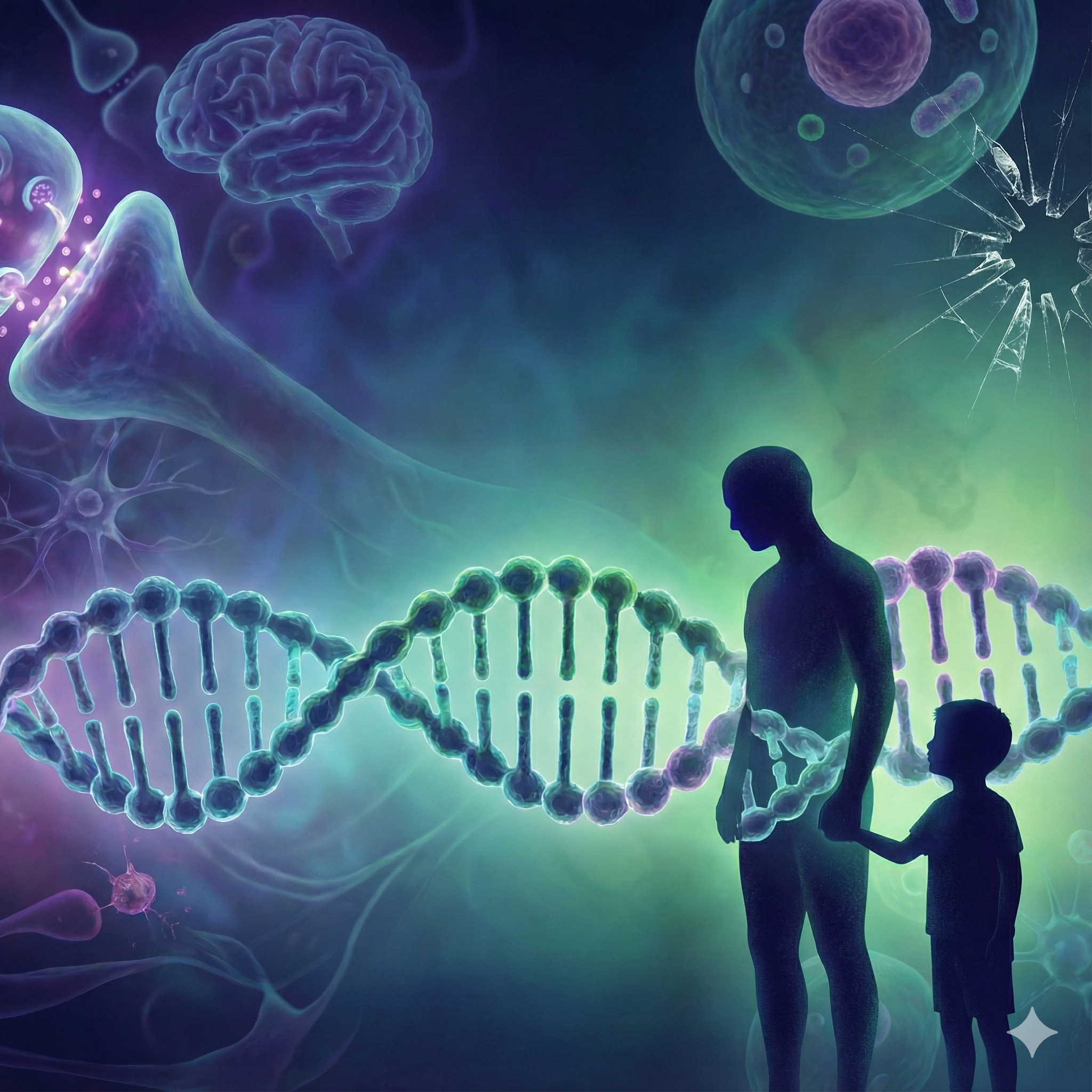
Gene-parents and epigene-parents: the double helix of trauma. from genetics to emotional dysregulation: transmission mechanisms of C-PTSD
Abstract
Contemporary research in relational psychotraumatology redefines the boundary between biological inheritance and lived experience. This contribution analyzes the concepts of "Gene-parents" (Geni-tori: transmission of the genetic code) and "Epigene-parents" (Epigeni-tori: modulation of gene expression through the environment), highlighting how chronic emotional dysregulation in caregivers acts as a powerful epigenetic factor. This mechanism predisposes new generations to PTSD (Post-Traumatic Stress Disorder) and C-PTSD (Complex PTSD) profiles, necessitating an integrated psychodiagnostic assessment protocol.
1. The epigenetics of dysregulation: beyond the DNA sequence
For a long time, science considered DNA an immutable destiny. However, studies promoted by the Italian Association of Psychology and Criminology (AIPC) and the Italian Center for Relational Psychotraumatology (CIPR) illuminate a more complex reality: the relational environment acts as a biological modulator.
In this framework, parents are not just transmitters of somatic traits (Gene-parents), but become architects of their children's biological regulation (Epigene-parents).
In cases of C-PTSD, the core of transmission is not just the trauma itself, but the profound emotional dysregulation that follows. When a caregiver suffers from a chronic inability to modulate their emotional reactions (oscillating between anxious/aggressive hyper-arousal and detached/depressive hypo-arousal), the child is exposed to a chaotic neurochemical environment. This toxic stress induces DNA methylation, "switching off" genes responsible for resilience and "switching on" those that keep the nervous system in a constant state of alert.
2. The intergenerational transmission of regulatory deficit
The work of Massimo Lattanzi and Tiziana Calzone emphasizes how unprocessed trauma transforms into a disorganized attachment style that perpetuates pathology.
Transmission occurs through a mechanism of "psychophysiological contagion":
- Failure of Co-regulation: The child learns to regulate their internal states through the relationship with the adult. If the adult is dysregulated, the child does not acquire the ability to self-soothe.
- Epigenetic Imprint: Constant exposure to parental dysregulation alters the child's HPA axis (hypothalamic-pituitary-adrenal). The result is an organism biologically set on the defensive, unable to discriminate between real threats and neutral stimuli.
Thus, we do not merely inherit the "genes" of trauma, but the epigenetic incapacity to manage emotions.
3. The paradigm of judicial relational psychotraumatology
Contributions published on the Association’s website in November 2025 mark a turning point in the application of this knowledge.
As defined by Lattanzi and Calzone (AIPC Editore), with the methodological contribution of AIPC, CIPR, and ONOF:
"Judicial Relational Psychotraumatology is the discipline that analyzes and measures the impact of relational traumas (familial, affective, attachment) on psychological and behavioral dynamics that acquire relevance in the judicial sphere, both civil and criminal."
This approach shifts the investigation from simple fact-finding to the scientific assessment of traumatic-relational roots. In a forensic context, understanding whether violent or dysfunctional behavior is the fruit of post-traumatic emotional dysregulation transmitted intergenerationally is fundamental. It allows for evaluations that go beyond mere sanction or moral judgment, aiming instead at interrupting the chain of trauma.
FORENSIC CLINICAL CASE
Application of the integrated AIPC/CIPR protocol
The approach presented here integrates clinical analysis, standardized psychodiagnostic evaluation, and psychophysiological investigation.
PROFILE: "Defensive Rage" Context: Technical consultancy in criminal proceedings (evaluation of personality and social dangerousness in a case of maltreatment). Subject: Marco, 42 years old. The Event: Disproportionate violent reactions during verbal domestic conflicts.
1. Anamnesis and Psychodiagnostic Evaluation Marco reports a childhood dominated by a violent and punitive father (authoritarian "Gene-parents").
- Test Evaluation: The administered psychodiagnostic protocols outline a personality picture with marked impulsivity and affective instability. A profile consistent with C-PTSD with paranoid hypervigilance emerges.
- SVITR Scale: Confirms exposure to multiple early relational traumas (witnessed and direct violence) with severe impact.
2. Assessment of dysregulation (relational epigenetics) The investigation focuses on the violence trigger mechanism.
- Psychophysiological Analysis (Biofeedback): Subjected to stress stimuli, Marco passes from a state of quiet to a peak of neurovegetative activation (hyper-arousal) in fractions of a second.
- Interpretation: Marco's nervous system is biologically set on "death threat" mode even in the face of trivial conflicts. His emotional dysregulation is of the explosive/defensive type. He acts as an "Epigene-parent," replicating the violence suffered because his organism is unable to filter the perceived threat.
3. Technical conclusions The technical report highlights that social dangerousness is strictly correlated to traumatic emotional dysregulation. Although imputability (criminal liability) remains intact, it is emphasized that a purely detention-based path will not modify biological reactivity. The necessity of a specific treatment for hyper-arousal management (anger regulation) is indicated as a necessary condition to reduce the risk of recidivism and interrupt the transmission of violence.
References and institutional contacts
For further details on protocols, the SVITR Scale, and research activities:
- Website: www.associazioneitalianadipsicologiaecriminologia.it
- Email: aipcitalia@gmail.com
- Phone/WhatsApp: 3924401930
The contents refer to AIPC Editore publications and website posts updated as of November 2025, curated by Massimo Lattanzi and Tiziana Calzone.
Hashtag:
#italian center for relational psychotraumatology #femicide #national observatory on familial homicides #italian association of psychology and criminology #relational traumatic resonance #partner paradox #relational bubble #complex post-traumatic stress disorder

..png "La grammatica della violenza nei legami: l'analisi criminologica del report ONOF (25 giugno - 1° luglio 2026).")
..png "Delitti familiari e reati di prossimità: il report settimanale ONOF (18-24 giugno 2026).")