Family homicide report: January 8–14, 2026 – Male victim and alleged perpetrator: A turn of the tide?
Edited by: Massimo Lattanzi, Tiziana Calzone, and Federico Maroli
Entities: Italian Association of Psychology and Criminology (AIPC), Italian Center for Relational Psychotraumatology (CIPR), National Observatory on Family Homicides (ONOF).
Abstract
This article analyzes family crimes occurring during the week of January 8–14, 2026, through the A.S.V.S. (A.I.P.C. Scientific Violence Screening) integrated scientific protocol. The investigation, conducted by the multidisciplinary team coordinated by Dr. Lattanzi and Dr. Calzone, focuses on clinical rather than social risk assessment. Through the lens of relational psychotraumatology, the homicidal event is interpreted as a severe acting out resulting from the loss of impulse control. This phenomenon is closely linked to emotional dysregulation and the narrowing of the window of tolerance typical of individuals with C-PTSD, as documented by ONOF, CIPR, and AIPC research.
Data collection methodology: OSINT approach
The analysis is based on an OSINT (Open Source Intelligence) research methodology. The data presented do not derive from institutional sources but from the systematic collection, classification, and analysis of articles published in newspapers and open sources regarding news events. This approach allows for a real-time reading of "family crime," understood as murder, attempted murder, or suicide occurring between individuals linked by various levels of familiarity (acquaintance, kinship, affectivity).
The excellence of relational psychotraumatology: The V.E.R.A.® protocol at the International Summit
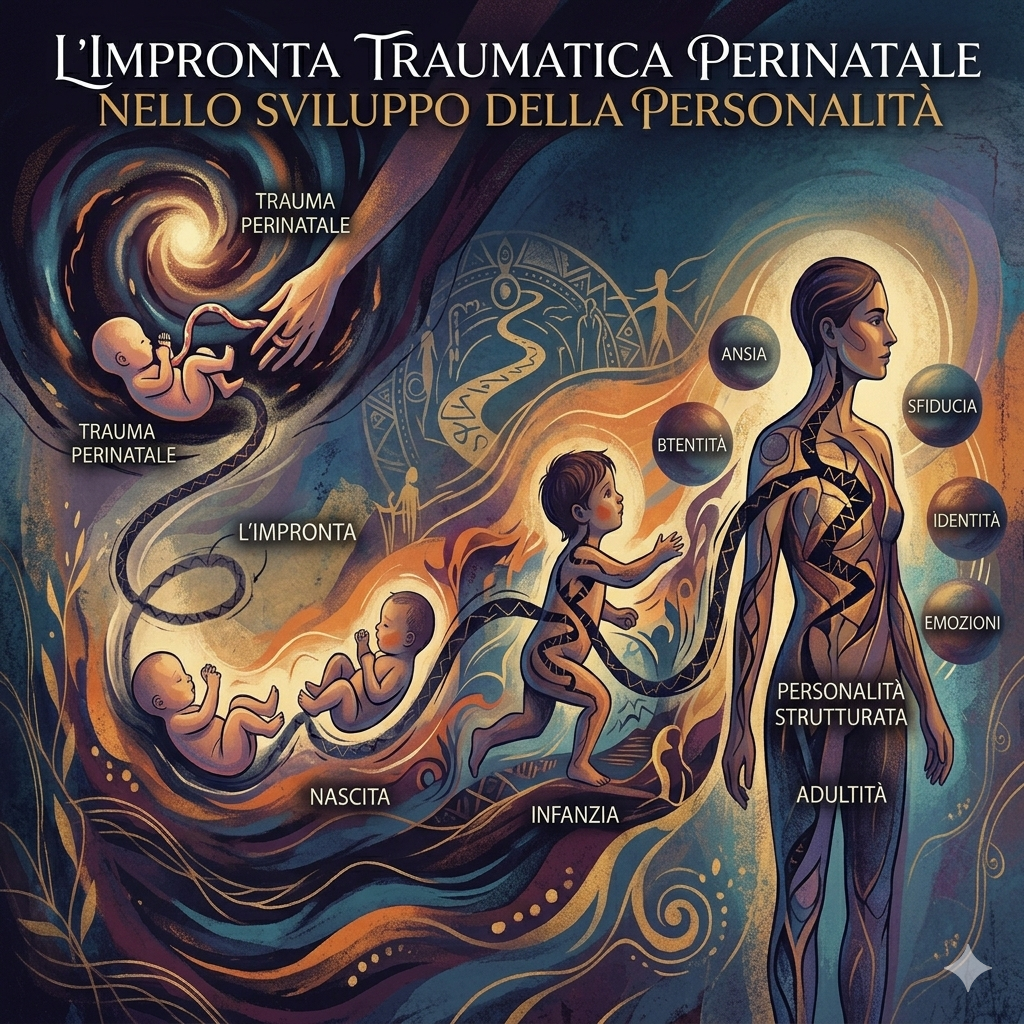
On February 13, 2026, during the International Summit celebrating 25 years of AIPC activity, the V.E.R.A. Protocol (Relational and Attachment Processing Evaluation) will be officially presented. This tool represents the state of the art in predictive diagnosis and treatment of Relational C-PTSD, marking the definitive transition from descriptive clinics to neurobiological precision therapy.
A new generation integrated scientific protocol
The V.E.R.A. Protocol is not a simple test, but a complex diagnostic architecture aimed at clinical risk assessment. The upgrade of the diagnostic component lies in the updating and integration of tools designed to map the subject's neurobiological vulnerability. The protocol integrates:
- Specific AIPC/CIPR Anamnesis: Essential for decoding the history of primary bonds and the impact of early relational traumas.
- SVITR and V.E.R.A. Scales: Updated tools to map the impairment of visceral safety (Area M) and the self-efficacy structure (Area P), critical indicators of the state of the autonomic nervous system.
- Upgrade of the ASVS Protocol: Severe acting out is understood as a loss of impulse control; for this reason, the new generation testing component proves to be an extraordinarily effective diagnostic weapon for tracing the personality profile and accurately revealing any underlying degree of psychopathology.
- Biofeedback and Clinical Interviews: Real-time monitoring of psychophysiological parameters provides objective validation of emotional dysregulation, supporting data emerged from specialized clinical interviews.
The event: February 13, 2026 | Rome
The presentation of the protocol will be the heart of the International Summit "From C-PTSD to Pet Therapy." Research data from the Rome and Pescara centers will be released, documenting how the window of tolerance—often extremely reduced in traumatized patients—can be reopened and stabilized through the integration of these cutting-edge methodologies.
"The V.E.R.A. Protocol represents the watershed between the condemnation to trauma repetition and the concrete possibility of healing."
Join the Summit
- Date: February 13, 2026 (3:00 PM – 7:00 PM)
- Venue: SALA TEVERE, Lazio Region – Via C. Colombo, 212, Rome
- Contacts: WhatsApp +39 392 4401930 | aipcitalia@gmail.com
- Web: www.associazioneitalianadipsicologiaecriminologia.it
- Free entry. Reservation mandatory.
Profile analysis:
In line with ONOF and AIPC studies, we report the in-depth analysis based on the news cases of the reference week.
Profile of the family homicide victim
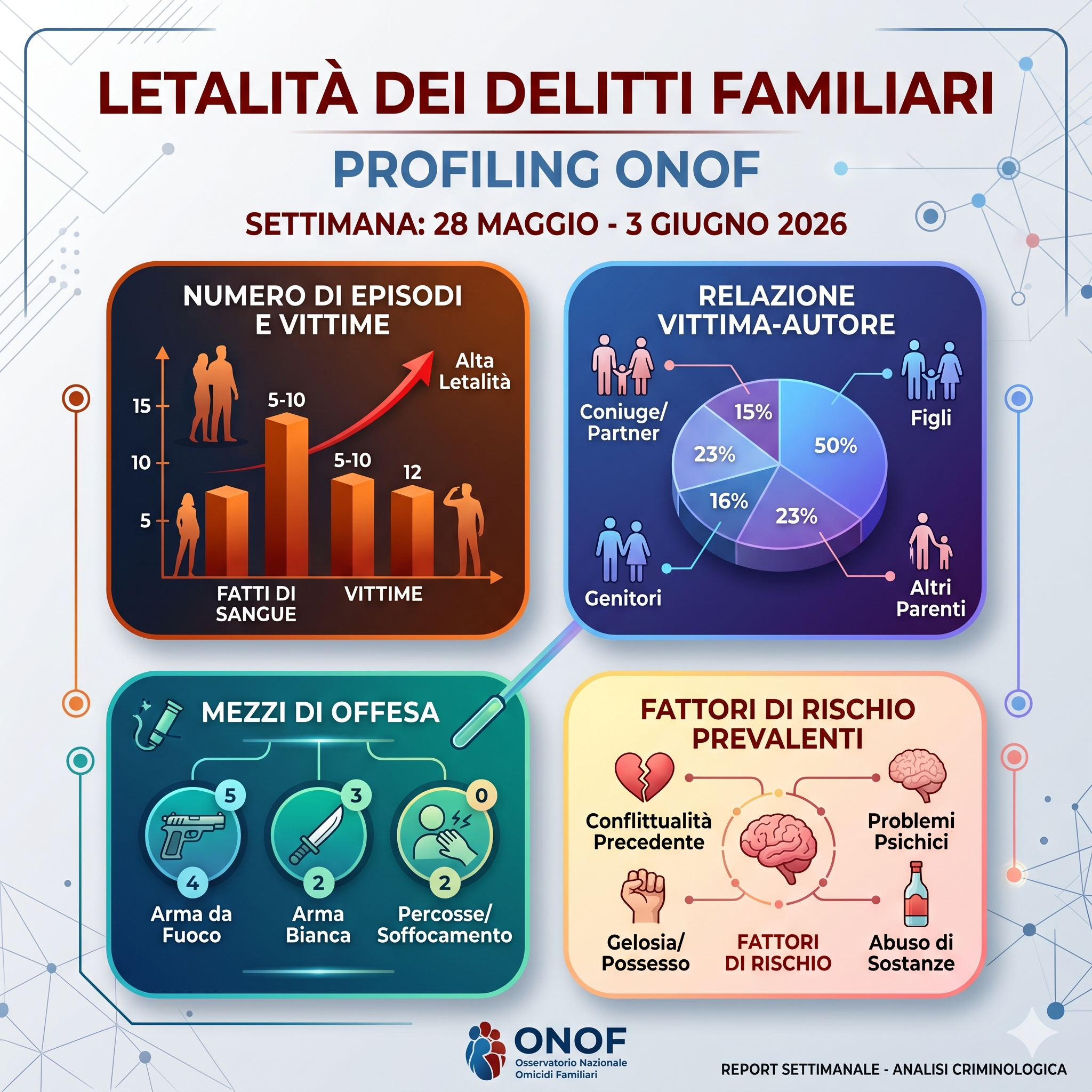
- Gender - Male (75%): Data confirm that, in terms of percentage, the male is the prevalent victim of family and relational homicides during the period under examination. This evidence emphasizes the need for a risk assessment that does not exclude the male gender from protection protocols.
- Age - Equally distributed (25% per bracket): The statistical uniformity across age groups (18-35, 36-53, 54-71, 72+) indicates that lethal vulnerability is not linked to a specific biological phase but to cross-sectional relational dynamics. From a psychotraumatological perspective, this suggests that the perpetrator's emotional dysregulation can strike any relational target regardless of age.
- Familiarity - Acquaintances (75%): This is the most significant datum; the victim is predominantly a person with whom the perpetrator has a bond of acquaintance, proximity, or colleagueship. The crime does not occur only within the couple, but within a social network where the "degree of familiarity" becomes the ground for acting out.
- Geographic Distribution - Northern Italy (75%): The concentration of cases in the North highlights a territorial specificity for this timeframe that warrants constant monitoring to identify local risk clusters.
- Weapon Used - Firearm (75%): The predominant use of firearms indicates immediate lethality. From the perspective of the window of tolerance, the use of a firearm often represents an explosion of hyper-arousal where physical distance from the weapon does not prevent the destructive impulse, making the crossing of the critical threshold instantaneous and irreversible.
Profile of the alleged family homicide perpetrator
- Gender - Male (100%): The data reveals that 100% of the perpetrators belong to the male gender. In terms of relational psychotraumatology, this confirms the need to focus interventions on anger management and male emotional regulation.
- Age - Homogeneous Distribution (25% per bracket): The perpetrator does not belong to a specific age group. This suggests that the risk of acting out is a variable linked to personality structure and traumatic history (such as C-PTSD) rather than an age factor.
- Familiarity - Acquaintances (75%): Most perpetrators struck people within their extended social network. This is central for ONOF and AIPC, as it qualifies family crime not just as domestic, but as a failure of regulation within bonds of proximity and colleagueship.
- Weapon Used - Firearm (75%): Clinically, the use of such a weapon can be interpreted as the result of acute emotional dysregulation: the subject, exiting their window of tolerance, resorts to a tool that allows for an immediate and definitive assault to interrupt an intolerable state of internal tension.
Clinical interpretation: Dysregulation and window of tolerance
ONOF analysis highlights how acting out occurs when the subject exits their window of tolerance. In individuals with complex relational trauma (C-PTSD), this window is extremely narrow; stimuli perceived as threatening within the degree of familiarity (acquaintance, proximity, kinship) trigger emotional dysregulation that the nervous system cannot modulate. The "acting out" represents the failure of the ability to contain the aggressive impulse in the face of hyper-arousal dysregulation.
Case analysis: Neighborhood homicide
Consider the case in Cosenza, where a man fired shots at a neighbor who was parking.
- Relational Variable: "Familiarity" here is represented by the neighborhood relationship (acquaintances).
- Clinical Dynamics: A neutral daily event (parking) is perceived by the perpetrator's threat system as an intolerable invasion.
- Exit from Window of Tolerance: The subject experiences a peak of activation that restricts his judgment capacity.
- Emotional Dysregulation: The inability to regulate anger or anxiety leads to the belief that elimination of the stress source is the only way to restore internal balance.
- Acting Out: The perpetrator claims he "only wanted to intimidate," but the final action (the lethal shot) confirms the loss of impulse control typical of severe dysregulation.
Conclusion
Data collected between January 8 and 14, 2026, confirm the importance of an assessment that integrates psychodiagnostics and psychophysiology, as provided by the A.S.V.S. protocol, to identify precursory signs of violence. It is essential to intervene on self-regulation capacity to prevent dysregulation from escalating into family crimes.
If you feel that complex family or relational dynamics are influencing your emotional regulation, CIPR offers specialized support in Pescara and Rome, integrating methodologies such as biofeedback.
- WhatsApp: +39 392 4401930
- Email: aipcitalia@gmail.com
- Web: www.associazioneitalianadipsicologiaecriminologia.it
© 2026 AIPC Editore – All rights reserved.