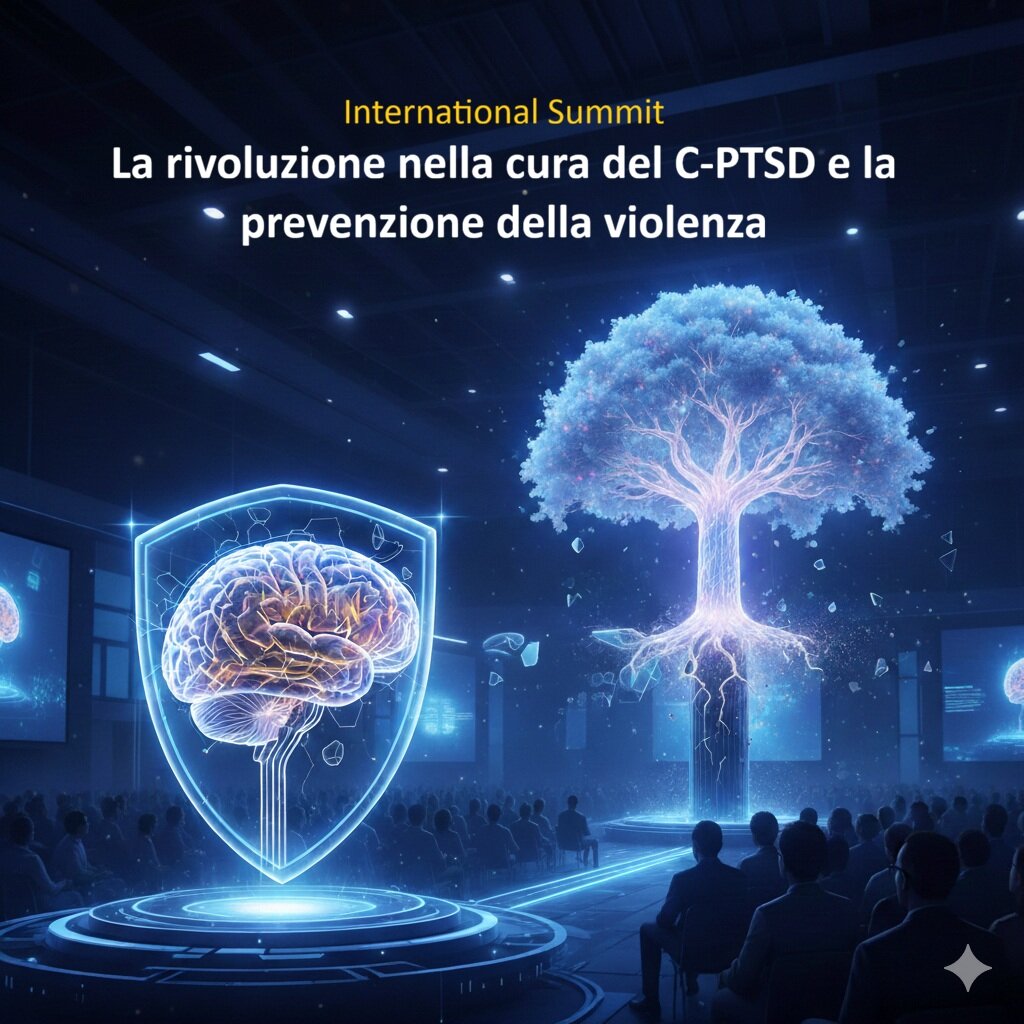
Second part of the Summary of the International Summit, February 13, 2026: The revolution in C-PTSD care and violence prevention
AIPC 25th Anniversary Special: A quarter-century at the service of clinics and the community
Introduction: Twenty-five Years of Commitment and Innovation
The International Summit "From C-PTSD to Pet Therapy," held on February 13, 2026, in the prestigious setting of the Sala Tevere at the Lazio Region, represented a high-profile scientific and institutional meeting. It coincided with the historic milestone of the 25th anniversary of A.I.P.C. (Italian Association of Psychology and Criminology). This anniversary was honored through the synergy of the organizing associations: A.I.P.C., CIPR (Italian Center for Relational Psychotraumatology), Hakuna Matata, and MEDEA ODV.
Brain Awareness Week 2026: The mind at the center of prevention. Don't miss the free webinar “UNDERSTANDING THE MIND TO PREVENT VIOLENCE.” We will explore clinical tools to recognize and prevent violence through emotional regulation. Click the link to participate: https://www.settimanadelcervello.it/event/comprendere-la-mente-per-prevenire-la-violenza/
The event marked a quarter-century of research dedicated to transforming trauma into a resource, with the fundamental support of Media Partner Casa Radio and Paolo Leccese for constant media coverage. Special thanks for the success of this celebration go to Dr. Francesca Romana Trombaccia, clinical psychologist and relational psychotherapist, who managed the moderation, presentation, and opening/closing of the proceedings with commendable professionalism.
The organization also expresses deep gratitude to the Lazio Region for its hospitality and patronage. Essential recognition goes to the AIPC psychology interns — Alice Russo, Elisa Ninvaggi, Federica Ruffini, Federico Maroli, Francesca Candus, and Giulia Trovato — whose operational contribution was the fundamental engine for the success of this commemorative day.
Download the slides for the Second Part of the Summary: [click here for slides]
Complex PTSD in ICD-11: From Conceptual Foundations to Personalised Treatment
Speaker: Karatzias Thanos, Associate Dean for Research & Innovation at Edinburgh Napier University, UK, and Clinical Psychologist at the Rivers Centre for Traumatic Stress, Edinburgh.
The introduction of ICD-11 by the World Health Organization marked a historic turning point, clearly distinguishing PTSD from C-PTSD (Complex PTSD). While PTSD focuses on re-experiencing, avoidance, and a sense of threat, C-PTSD adds three fundamental pillars grouped as "Disturbances of Self-Organization" (DSO):
- Affective Dysregulation: The inability to manage emotional surges.
- Negative Self-Concept: Persistent feelings of failure and worthlessness.
- Relational Difficulties: A constant distance or disconnection from others.
Global Impact and the Italian Case
Research shows that trauma knows no borders, but its prevalence is alarming. In Italy, a study of high school students found that 9.11% suffer from PTSD and 4.06% from C-PTSD, with higher rates among women. Globally, C-PTSD affects up to 12.9% of the population in the UK and reaches dramatic peaks among veterans (56.7%) and refugees (over 50%).
The Weight of the Past: Childhood Trauma
Adverse events such as verbal abuse (36%), physical abuse (34%), or emotional neglect (36%) violate the perception of a benign world. Research highlights that childhood traumas are responsible for nearly 30% of all mental disorders in adulthood.
A New Hope: ESTAIR Modular Therapy
With dropout rates of 50% in traditional therapies, Prof. Karatzias proposes a person-centered, modular approach. The ESTAIR (Enhanced STAIR Narrative Therapy) protocol represents the cutting edge of treatment:
- Tailored Therapy: Based on the specific needs of the patient.
- Specific Modules: Targeted interventions for each cluster (Emotional Regulation, Relationships, Self, PTSD).
- Results: The RESTORE trial showed that 84% of patients treated with ESTAIR achieved remission of the C-PTSD diagnosis, compared to only 18.2% in standard treatment.
Pet Therapy as an Emotional Regulation Intervention
Speaker: Dr. Pamela Saccoccio, Psychologist and Psychotherapist, President of Hakuna Matata Psychotherapy & Pet Therapy.
Dr. Saccoccio analyzed the integration of Animal-Assisted Interventions (AAI) as a clinical tool within evidence-based and trauma-informed models. The animal acts as a bridge between body and relationship, facilitating:
- Co-regulation and Grounding: Reducing cortisol while increasing oxytocin and Heart Rate Variability (HRV).
- Social Threat Reduction: Softening the perception of danger in the clinical setting.
- Window of Tolerance: Allowing repeated experiences of safety necessary for stabilization.
From Emotional Dysregulation to Regulation with Pet Therapy
Speakers: Dr. Pamela Saccoccio and Dr. Massimo Lattanzi (AIPC Coordinator).
This pilot study marks a methodological breakthrough by combining gender studies with neurophysiological measurement using Biofeedback.
- Biofeedback: Making the Invisible Visible. This technology monitors hyper-arousal (fight/flight) and hypo-arousal (freeze), proving that interaction with an animal acts as a powerful biological regulator.
- Exceptional Results: In hyper-activated subjects, a drastic reduction in alert levels was recorded. One case showed muscle tension dropping from +370.6% to +39.55% after treatment.
- Control Group: Showed no systematic improvement, confirming benefits are directly linked to the animal-integrated intervention.
Conclusions: A Quarter-Century Toward New Hope
The research presented confirms that the human-animal bond is a powerful medicine to "repair" the circuits of the Self damaged by trauma. The Summit marked a point of no return in understanding complex trauma, where science meets empathy.
Upcoming 25th Anniversary Events:
- March 2026: Brain Awareness Week (March 27) free webinars.
- April 2026: New seminar cycle starting April 22 on risk analysis and relational psychotraumatology.
- May/June 2026: Technical workshops on Biofeedback and AAI integration.
Support Our Research:
- 5x1000 (Italy): Fiscal Code 97238660589.
- Donations: IBAN IT83I0760103200000056039688.
Contacts:
- Website: www.associazioneitalianadipsicologiaecriminologia.it
- Email: aipcitalia@gmail.com
- WhatsApp: 3924401930 (Daily 11:00 AM – 4:00 PM)