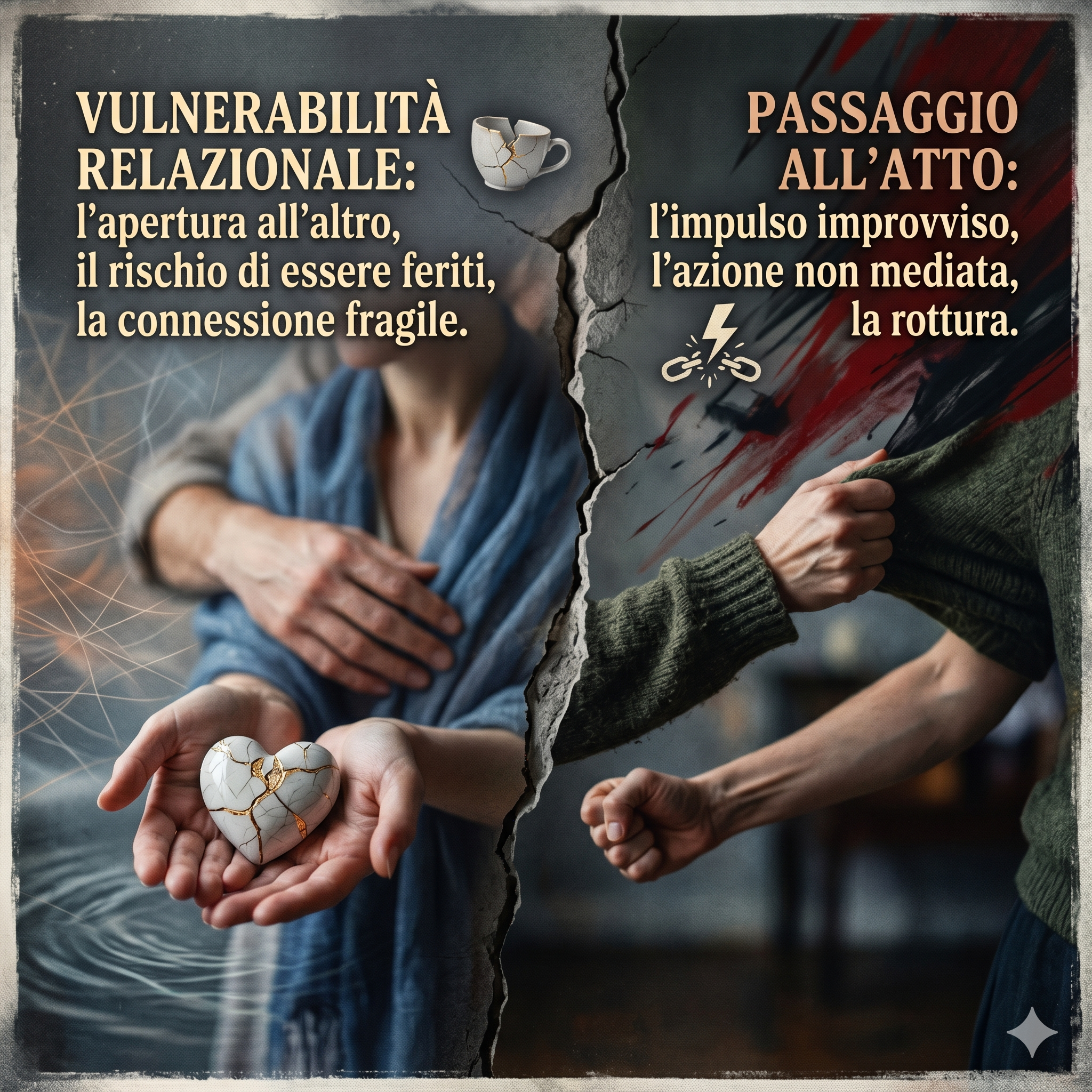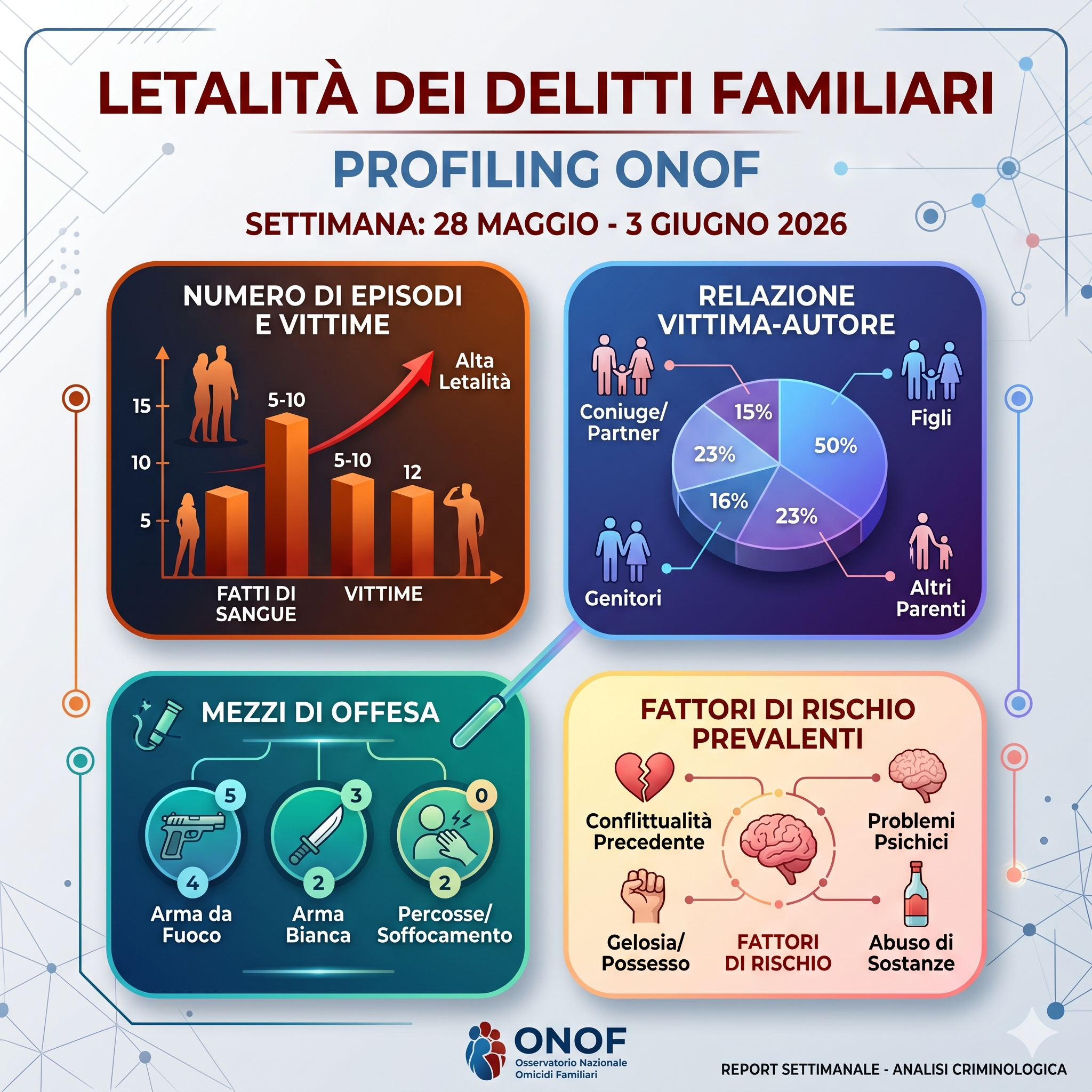
ONOF Report week December 4 – 10, 2025: the trap of familiarity and the body as a weapon. An OSINT analysis on family homicides.
Curated by: Dr. Massimo Lattanzi, Dr. Tiziana Calzone, Dr. Francesca Candus.
Reference Entities: AIPC (Italian Association of Psychology and Criminology), CIPR (Italian Center for Relational Psychotraumatology), ONOF (National Observatory on Family Homicides).
Abstract
This work analyzes data regarding family crimes recorded in the week of December 4 to 10, 2025. Through an OSINT (Open Source Intelligence) data collection methodology, based exclusively on open journalistic and non-institutional sources, it was possible to trace an alarming profile of domestic and relational violence. The most marked statistical evidence is the predominance of direct physical aggression (75% in homicides) and a clear geographic polarization in the South and Islands. The study highlights how "familiarity" transforms into a deadly trap, where emotional dysregulation and the inability to manage conflict make the other's body a target to be annihilated manually.
Methodological note: OSINT data collection
It is fundamental to premise that the data exposed here fall within the A.I.P.C. classification and derive from OSINT monitoring. The analyzed cases, defined as "family crimes," refer to news events reported by media outlets and not by institutional sources. This methodology allows for the detection of the social "real scope" of the phenomenon in real-time, including homicides, attempted homicides, suicides, and attempted suicides occurring between people linked by kinship, affective ties, or simple acquaintance/colleagueship.
Psycho-criminological analysis and profiling
From the analysis of the collected data, a clear gender dichotomy emerges, reflecting deeply different relational dynamics, albeit united by the fatal outcome.
1. The profile of the victim: the trap of familiarity
The homicide victim of this week presents an equal distribution between sexes (50% men, 50% women), but with a substantial divergence in the relational context:
- Women (The Betrayal of the Nest): 100% of female victims were killed by a Relative. This figure confirms the dramatic trend where the place that should activate the CARE system (the family) becomes the theater of lethal threat.
- Men (The Social Conflict): 100% of male victims were killed by an Acquaintance. Here, violence explodes within the extended social perimeter, likely triggered by dynamics of competition, honor, or distorted territoriality.
Psychotraumatological Lens: The female victim suffers a primary betrayal trauma; the attack comes from those who biologically or legally should protect. The male victim, instead, is often involved in an escalation of RAGE (primary emotional system) where negotiation fails and the other becomes an obstacle to be struck down.
2. The profile of the perpetrator: male and senile impulsivity
The prevalent perpetrator is Male (75%), but the demographic data reveals a critical intergenerational polarization:
- Perpetrators are divided equally among young adults (18-35 years), mature adults (36-53 years), and the elderly (72+).
- Particularly alarming is the involvement of the 72+ age group, representing both 25% of perpetrators and 50% of victims.
Psychotraumatological lens: The presence of perpetrators and victims in the over-70 group suggests a collapse of resilience in contexts of fragility and forced cohabitation. The hyper-activation of threat systems (FEAR/RAGE) in elderly subjects, perhaps cognitively vulnerable, leads to a "short circuit" where the inability to verbalize distress transforms into violent action.
ETIOPATHOGENESIS OF SERIAL VIOLENCE: RETROSPECTIVE STUDY ON A SAMPLE OF 20 SUBJECTS. Correlations between complex post-traumatic stress disorder (C-PTSD), ANS dysregulation, and self-care strategies (STAS). Part one Link to article
3. The weapon and the modality: direct contact
The most significant and "ferocious" datum of the week is the absence of firearms or edged weapons in consummated homicides in favor of Physical Aggression (100% for male perpetrators, 75% total).
Psychotraumatological Lens: Killing with bare hands or through beatings indicates total emotional dysregulation. There is no "mediation" by an instrument (gun or knife) that creates distance; there is skin-to-skin contact. This suggests an uncontrolled explosion of the RAGE system that bypasses every higher cortical function. The perpetrator must "feel" the destruction of the other, indicating a dissociative state or extreme emotional overwhelm where the goal is the immediate physical annihilation of the stress source.
4. Geography of trauma
75% of homicides occurred in the South and Islands. The territorial concentration, combined with the brutal modality (physical aggression) and the relational typology (acquaintances/relatives), suggests an environmental context where social support networks might be saturated or ineffective in containing conflicts before they degenerate.
FCP – AIPC Webinar Summary, December 12, 2025: Beyond the symptom – Decoding addiction through trauma and the S.T.A.S. scale Link to article
Conclusions
The data from the week of December 4 to 10, 2025, are not simple numbers: they are the x-ray of a social and relational fracture. Education and emotional awareness remain the decisive watershed between the condemnation to repeat violence and the possibility of healing. We are facing a silent pandemic of affective dysregulation, where the inability to manage frustration and conflict transforms fathers, grandfathers, and acquaintances into brutal executioners. When the word dies, the body acts. And in this week, the body acted to kill, without filters, in the most archaic way possible: with physical force. It is imperative to intervene on emotional regulation mechanisms and support for families and communities, working to reactivate the CARE and PLAY systems that seem to have shut down, leaving the field open to blind and devastating RAGE.
Do you need support or want to learn more? If you recognized yourself in these dynamics or feel the need for a professional consultation, you are not alone.
Website: www.associazioneitalianadipsicologiaecriminologia.it
Email: aipcitalia@gmail.com
WhatsApp Phone: 3924401930