First Part of the International Summit Summary - February 13, 2026: The revolution in C-PTSD care and violence prevention
AIPC 25th Anniversary Special: A quarter-century at the service of the clinic and the community
Introduction: Twenty-Five Years of Commitment and Innovation
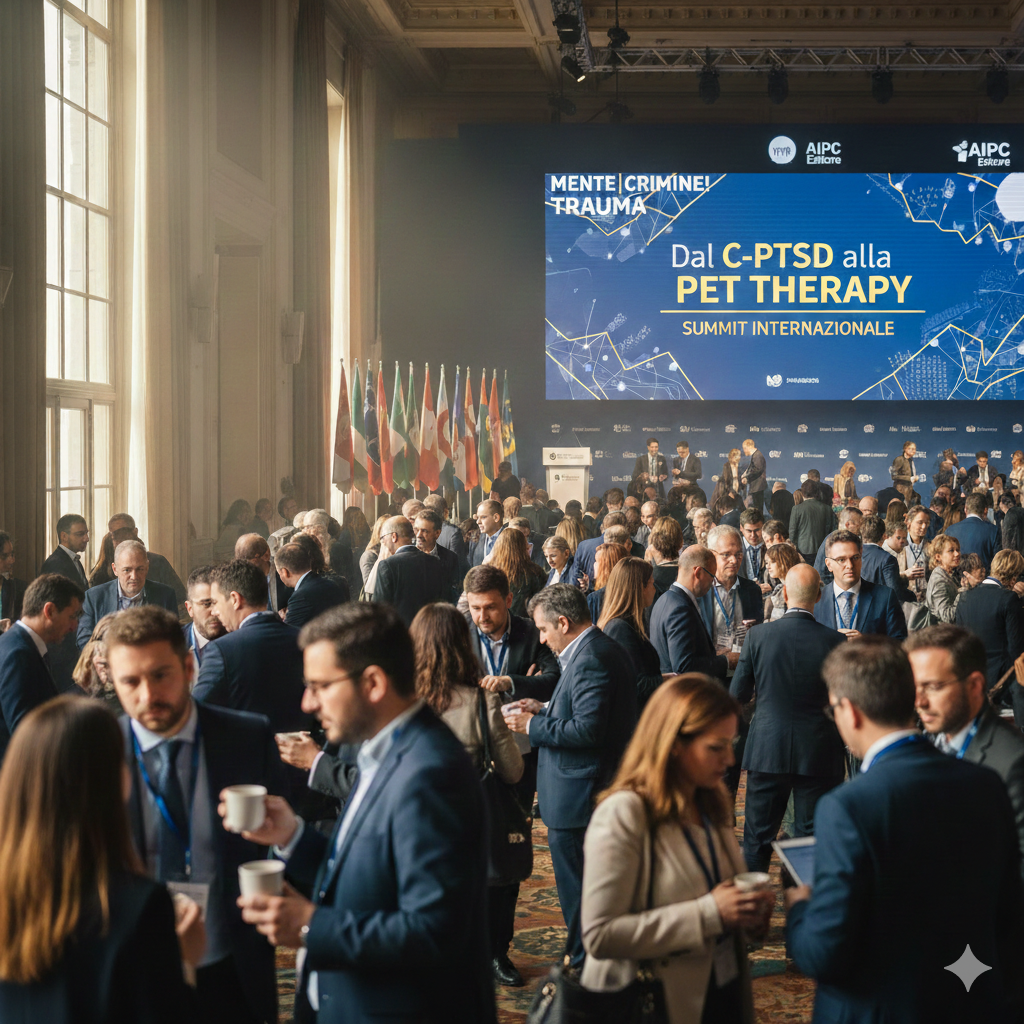
The International Summit "From C-PTSD to Pet Therapy," held on February 13, 2026, in the prestigious setting of the Sala Tevere at the Lazio Region headquarters, represented a high-profile scientific and institutional forum. This event coincided with the historic milestone of the 25th anniversary of the A.I.P.C. (Italian Association of Psychology and Criminology). This prestigious anniversary was honored thanks to the synergy between the organizing associations: A.I.P.C., the CIPR (Italian Center for Relational Psychotraumatology), the Hakuna Matata Association, and MEDEA ODV.
The event marked a quarter-century of research dedicated to transforming trauma into a resource, with the fundamental support of Media Partner Casa Radio and Paolo Leccese for consistent media coverage. Special thanks for the success of this celebration go to Dr. Francesca Romana Trombaccia, clinical psychologist and relational psychotherapist, who managed the moderation, presentation, opening, and closing of the proceedings with commendable professionalism.
The organization also wishes to express deep gratitude to the Lazio Region for its hospitality. Essential recognition goes to the AIPC psychology interns — Alice Russo, Elisa Ninvaggi, Federica Ruffini, Federico Maroli, Francesca Candus, and Giulia Trovato — whose operational contribution was the driving force behind the perfect execution of this commemorative day.
A round of applause goes to all the speakers who enriched the debate with contributions of immense clinical and scientific value:
- Dr. Tiziana Calzone, founder of AIPC, who analyzed the evolution of trauma in contemporary society.
- Prof. Thanos Karatzias, who illustrated the new frontiers of C-PTSD in the ICD-11.
- Dr. Massimo Lattanzi, founder of AIPC, who presented the “I AM WELL!” circuit and the use of biofeedback in emotional regulation.
- Dr. Carmen Pellino, who presented data on the somatization of relational trauma.
- Dr. Pamela Saccoccio, who delved into the integration of Animal-Assisted Interventions (AAI) in the clinical setting.
- Institutional representatives Luce Meola (President of CPO Lombardia) and Rosa Pestilli (President of CPO Abruzzo), for their commitment to prevention and equal opportunities.
Finally, a heartfelt thank you goes to all participants, whose large presence and proactive attitude until the conclusion of the works transformed this Summit into an authentic laboratory of ideas and hope for the future of trauma care.
Featured Institutional Contributions
Dr. Francesca Romana Trombaccia As a clinical psychologist and relational psychotherapist, Dr. Trombaccia carried out commendable work in moderating and presenting the event. With the same sensitivity and expertise she brings to her column “Due cuori e una capanna” on Casa Radio — where she explores crucial themes of relationships, living, and psychophysical well-being — she guided the scientific debate with rare balance.
Rosa Pestilli (President of the Equal Opportunities Council, Abruzzo Region) Founder of the "On the Road" project, Rosa Pestilli shared a fundamental testimony on the importance of capillary territorial interventions. She highlighted how the "On the Road" model represents a concrete response to the need for dynamic prevention, capable of leaving clinical settings to intercept social needs and promote a culture of relational awareness in an itinerant and accessible way.
Dr. Luce Meola (President of the Equal Opportunities Council, Lombardy Region) An attorney with solid experience in corporate law and sustainability (ESG), Dr. Meola emphasized the importance of synergy between institutions and clinical professionals to address the challenges of psychological well-being and the protection of vulnerable groups in contemporary society.
Trauma Architecture and Prevention Engineering
Speaker: Massimo Lattanzi, Psychologist, Psychotherapist, Founder and Coordinator of AIPC
Dr. Massimo Lattanzi’s intervention opened a necessary and revolutionary window into one of the greatest barriers in trauma treatment: the paradox of "I am well!". Far from being a sign of health, this statement is unmasked as a major neurobiological deception, an extreme defense mechanism hiding deep traumatic alexithymia.
- Interior Blindness: In people who have experienced complex trauma (C-PTSD), the verbal narrative is inherently unreliable. The brain learns to "disconnect" internal sensors to survive intolerable pain. This interior blindness prevents the subject from perceiving their own emotions and bodily signals.
- The A.I.P.C. Path: The method integrates clinical assessment with psychophysiological technology. Using Biofeedback allows the invisible to be made visible, transforming confused anguish into measurable parameters.
- From State to Choice: The goal is to create a conscious space between the traumatic stimulus and the automatic response, transforming a "biological destiny" marked by violence into a conscious choice of freedom.
Trauma and Bonds: A Clinical Analysis
Speaker: Dr. Tiziana Calzone, Psychologist, Psychotherapist, Coordinator and Founder of AIPC
Over twenty-five years, AIPC has witnessed a profound shift: the world, society, and the people seeking help have changed. Suffering today is more acute, with a constant lowering of the age of onset for disorders like anxiety and depression in children and adolescents. Trauma carries a heavy burden of guilt and shame, often leading people to bond through pain in dysfunctional relationships without boundaries. AIPC’s commitment focuses on prevention: it is necessary to make violence known so it can be recognized, dismantling the idea that "everything is permitted" within the family.
When Trauma "Passes Through the Body": Somatization
Speaker: Dr. Carmen Pellino, Psychologist and Psychotherapist, EMDR Europe Practitioner
Dr. Pellino outlined how prolonged relational trauma deposits itself in the body. Somatization is viewed as a powerful language of the nervous system attempting to communicate what the mind cannot yet process.
- Victims: 67% show a clinically significant elevation in somatization; the body becomes the primary channel for expressing distress.
- Authors of Violence: 61% show critical levels of somatization. In this category, the profile is often linked to narcissistic or negativistic personality traits, where vulnerability and intense shame fuel the need for control.
Upcoming 25th Anniversary Appointments
- March 2026: Free webinars for Brain Awareness Week (March 27) on emotional regulation.
- April 2026: A new seminar cycle with FCP starting April 22, focusing on risk analysis and relational psychotraumatology.
- May/June 2026: Technical meetings and experiential workshops on biofeedback and AAI integration.
Support Research: Your Contribution Matters
You can support AIPC's mission in two ways:
- 5x1000 Tax Donation: Use Fiscal Code 97238660589.
- Donations: Via Poste Italiane IBAN: IT83I0760103200000056039688.
Contact Info:
- Website: www.associazioneitalianadipsicologiaecriminologia.it
- Email: aipcitalia@gmail.com
- WhatsApp: 3924401930 (Daily 11:00 AM – 4:00 PM)