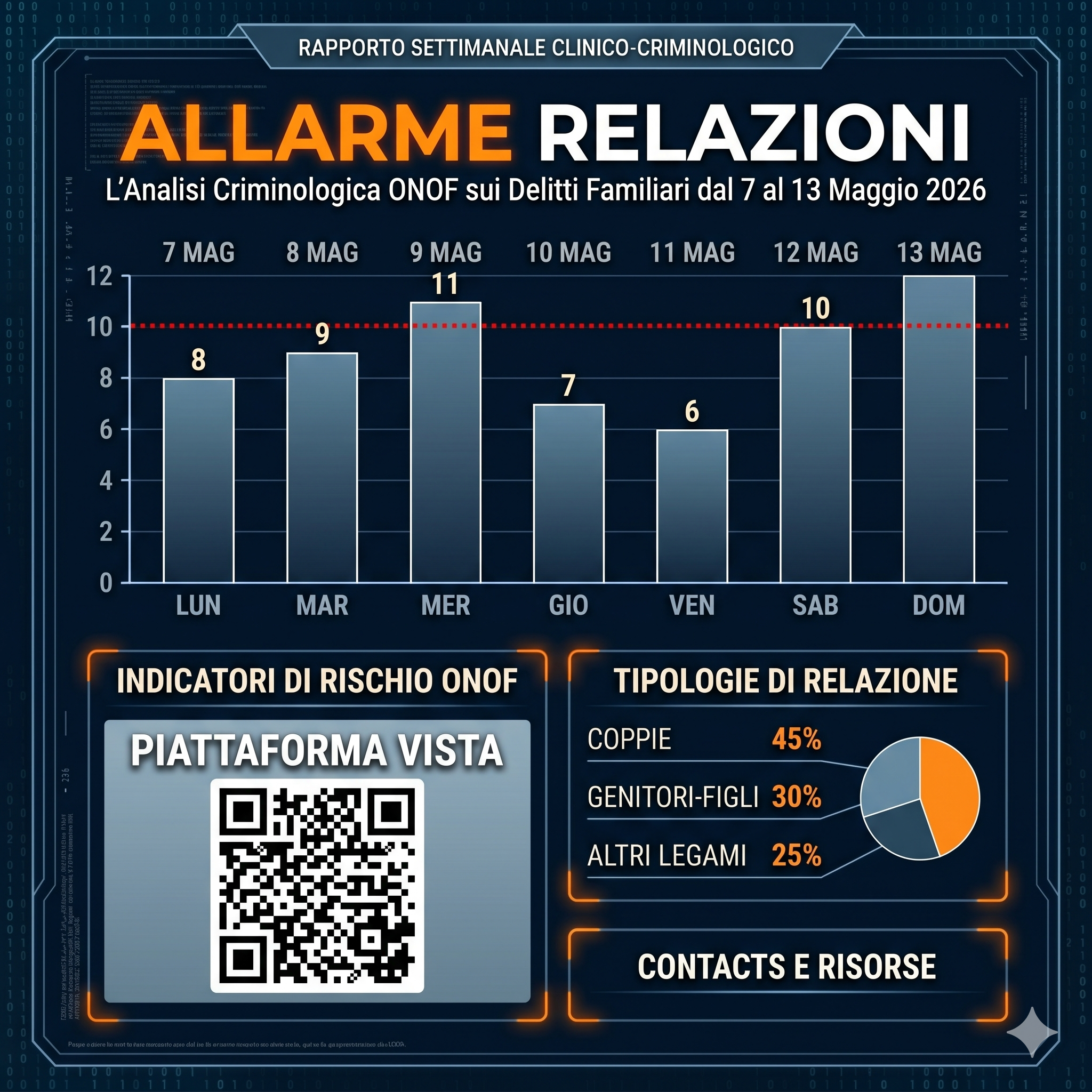
The equality of blood: 50% men and 50% women victims of family homicides
ONOF report | Week of february 12–18, 2026
Abstract
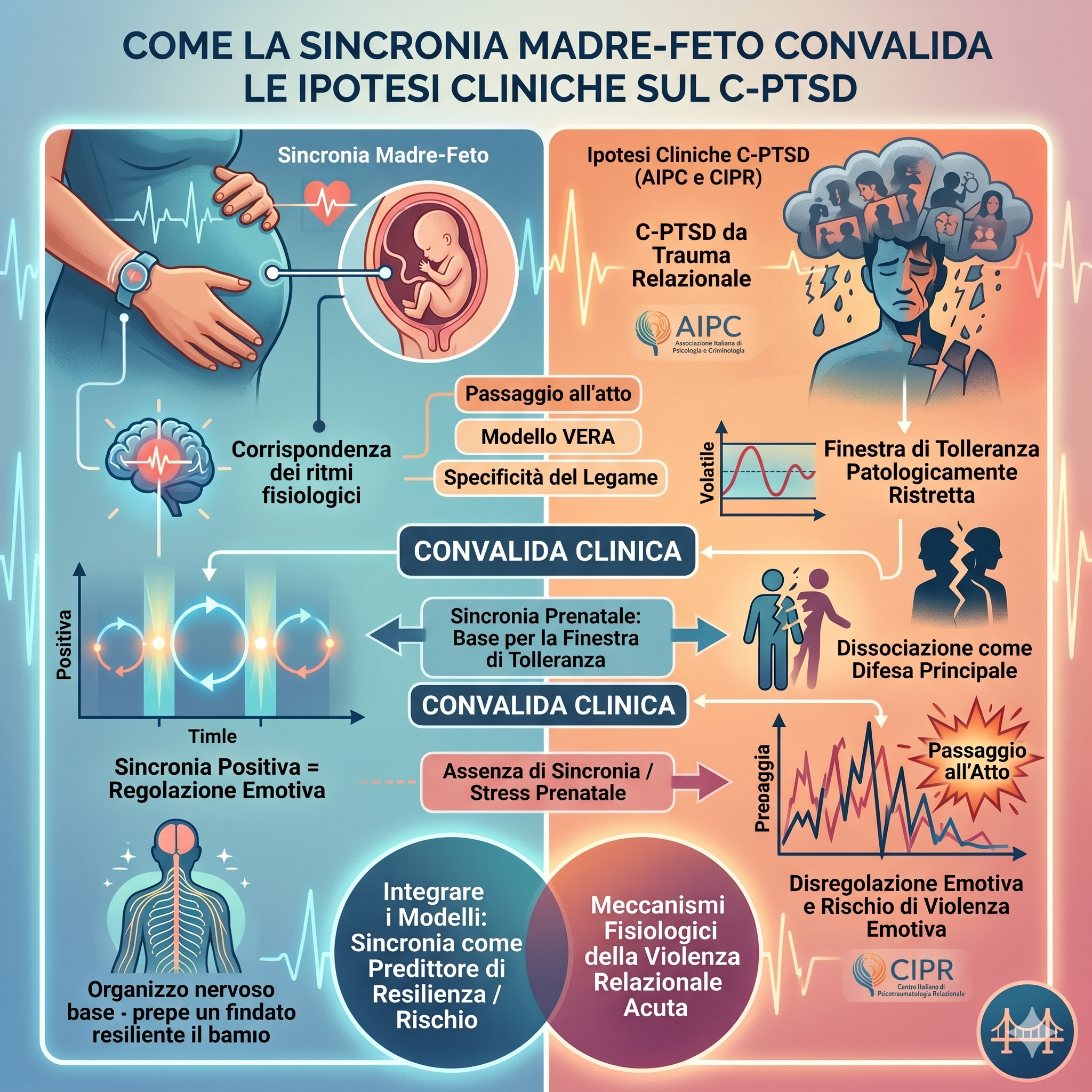
On the occasion of the 25th anniversary of the Italian Association of Psychology and Criminology (AIPC), this report analyzes the phenomenology of family crimes through the lens of relational psychotraumatology. The investigation, coordinated by Dr. Massimo Lattanzi and Dr. Tiziana Calzone, focuses on emotional dysregulation and the loss of impulse control leading to grave "acting out" (passage à l'acte). Risk assessment is conducted using the VERA protocol (Violence Emotional Risk Assessment), integrated to monitor the departure from the window of tolerance, which is notably narrow in individuals with complex trauma (C-PTSD).
OSINT methodology
Data were collected using OSINT (Open Source Intelligence) methodology, analyzing news reports from journalistic outlets during the period of February 12–18, 2026. This approach allows for constant monitoring of violent dynamics within the social fabric. Dr. Federica Ruffini and the AIPC intern group contributed to the drafting of this report.
Profile analysis of family homicide victims
The analysis focuses on profiling the variable of the degree of familiarity.
- Male Victim Profile (50% of cases):
- Gender: Male.
- Age: 36–53 years.
- Familiarity: Acquaintances.
- Geographic Distribution: Central Italy.
- Weapon Used: Sharp object/Edged weapon.
- Female Victim Profile (50% of cases):
- Gender: Female.
- Age: 72+ years.
- Familiarity: Relatives.
- Geographic Distribution: Northern Italy.
- Weapon Used: Not reported.
You can concretely contribute to our work:
- 5x1000 Tax Donation: C.F. 97238660589
- Donations: IBAN AIPC: IT83I0760103200000056039688 or via postal account no. 56039688.
Together, we can transform silenced suffering into a path of healing, ensuring the "window of tolerance" becomes a space for life rather than the limit beyond which tragedy occurs.
Profile analysis of family homicide perpetrators
The perpetrator profile reflects profound dysregulation of threat systems.
- Male Perpetrator Profile (100% of homicides this week):
- Gender: Male.
- Age: Equally divided between 36–53 (50%) and 54–71 years (50%).
- Familiarity: Acquaintances (50%) or Relatives (50%).
- Geographic Distribution: Divided between Central (50%) and Northern Italy (50%).
- Weapon Used: Sharp object (50%) or Not reported (50%).
Training event: Brain Awareness Week 2026
To mark Brain Awareness Week 2026, AIPC, CIPR, and ONOF present: "The Mind at the Center of Prevention." Don’t miss our free webinar: "UNDERSTANDING THE MIND TO PREVENT VIOLENCE." We will explore clinical tools for recognizing and preventing violence through emotional regulation. Register here: https://www.settimanadelcervello.it/event/comprendere-la-mente-per-prevenire-la-violenza/
Conclusion: prevention as a barrier to emotional dysregulation
The analysis of family crimes from February 12–18, 2026, confirms the urgent need for a clinical and psychotraumatological interpretation of homicidal phenomena. The synergistic work of AIPC, CIPR (Italian Center for Relational Psychotraumatology), and ONOF (National Observatory on Family Homicides) aims to decode the warning signs preceding the "acting out."
Through the lens of relational psychotraumatology, it is clear that preventing family homicides requires rigorous risk assessment via the VERA protocol. This tool identifies the vulnerability of threat systems and the restriction of the window of tolerance—critical in individuals with complex trauma, where the loss of impulse control transforms affective or social bonds into a theater of violence.
Support Contacts:
- E-mail: aipcitalia@gmail.com
- WhatsApp: +39 3924401930 (Available daily, 11:00 AM – 4:00 PM)
- Website: www.associazioneitalianadipsicologiaecriminologia.it
.png "La clinica del passaggio all'atto: Report ONOF dei delitti familiari (14-20 Maggio 2026)")