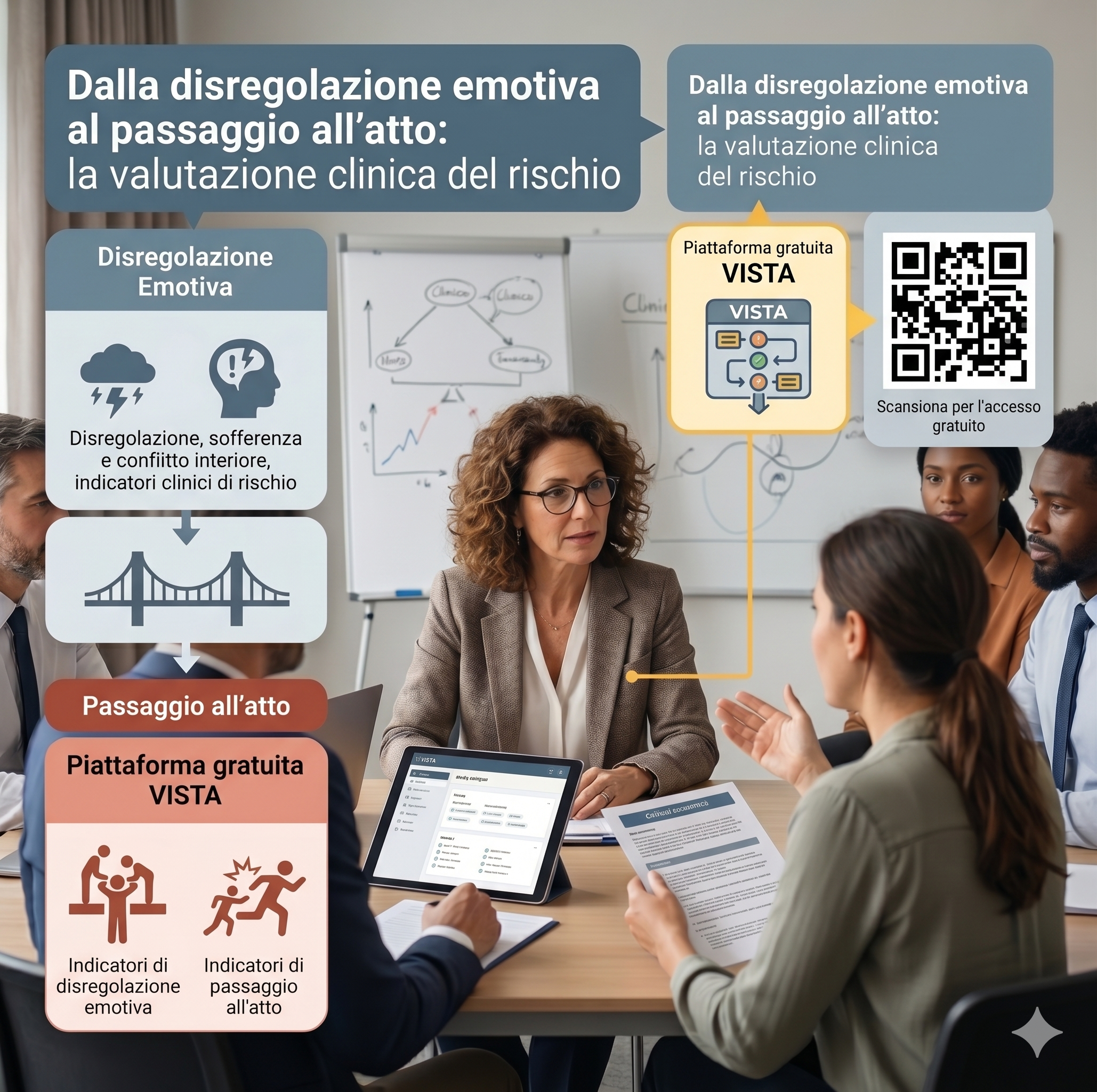
On May 15, 2026, from 5:30 PM to 6:30 PM, the second webinar of the training series organized by FCP and AIPC took place, titled "From Emotional Dysregulation to Acting-Out: Clinical Risk Assessment." The event generated significant interest, drawing the participation of over 250 professionals and field enthusiasts.
The meeting was led by Dr. Massimo Lattanzi, a psychologist, psychotherapist, and PhD who, alongside Dr. Tiziana Calzone, has coordinated the Italian Association of Psychology and Criminology (AIPC) since 2001. Established as a Third Sector Entity (ETS), AIPC operates through specialized departments dedicated to studying and countering interpersonal violence. Its primary focus is applied scientific research and the analysis of domestic homicides, viewed through the lens of relational psychotraumatology and the profiling of interpersonal familiarity.
The clinical and criminological framework presented during the webinar rests upon a solid empirical paradigm: since 2012, AIPC’s profiling and intervention protocols have relied on objective data gathered via validated psychodiagnostic tools and psychophysiological measurements executed with biofeedback. This monitoring allows clinicians to map emotional dysregulation parameters and analyze an individual's ability to remain within their "window of tolerance," providing a rigorous, scientific foundation for understanding trauma and violent acting-out.
Dr. Lattanzi introduced the topic with a reflection: traditionally, when facing a medical diagnosis, we expect an almost engineering-like precision. If someone fractures an arm, X-rays display a jagged white line across the bone; the physician points to it, and the diagnosis is complete. It is a reassuring mechanism because it is binary: broken or not broken. Human beings prefer problems to be unequivocally visible and labeled. However, when entering the realm of neurodevelopment, psychological trauma, or clinical criminology, that comforting landscape vanishes, giving way to "muddy waters" composed of shadows and fog.
The biological roots and epigenetics of trauma
Violence begins at a microscopic level, frequently beneath the surface of conscious awareness, where the nervous system loses its self-regulatory capacity due to unresolved relational traumas. This process can originate as early as prenatal vulnerability: if the uterine environment is flooded with cortisol caused by maternal stress, the infant’s nervous system becomes "set" to a perpetual state of alert.
Epigenetics demonstrates how traumatic experiences leave chemical markers on DNA, capable of turning specific genes on or off and altering brain architecture. It operates similarly to a brand-new computer with a hyper-sensitive antivirus software welded into its hard drive: the system overclocks and freezes while attempting to defend itself against trivial operations that are misperceived as lethal attacks.
This is not biological determinism, nor does it provide an alibi for the perpetrator. Rather, it represents a latent vulnerability that requires specific contexts to manifest. Recognizing it shifts the focus onto the responsibility of prevention: if an engine is prone to overheating, the solution is to install a better cooling system.
The mechanics of impulse control loss and C-PTSD
To understand how violence is triggered, the concept of the "window of tolerance" is foundational. If a dam's reservoir has been filled to capacity by years of accumulated trauma, a single drop—a misplaced word or a trivial frustration in traffic—is enough to cause the entire structure to collapse. This state of fragility is often the result of Complex Post-Traumatic Stress Disorder (C-PTSD), which differs from classic PTSD because it stems from prolonged abuse, abandonment, or severe neglect, frequently experienced during childhood.
In these scenarios, a literal "emotional hijacking" occurs: when faced with a threat, even a purely perceived one, the prefrontal cortex—which acts as the brain's logical and rational handbrake—suddenly deactivates. The amygdala takes total control. While this ancestral survival mechanism is highly efficient for fleeing a predator in the wild, it proves catastrophic when activated in a living room during a marital dispute, inevitably culminating in violent acting-out and a loss of impulse control due to an extremely narrow window of tolerance.
The traumatic bond (Trauma Bonding)
What is superficially labeled in popular culture as "toxic love" is, in reality, a biochemical trap. Within a trauma bond, the victim's brain fuses the terror of violence with intermittent moments of false affection and pacification offered by the abuser.
This destructive cycle generates extreme hormonal fluctuations between cortisol (the stress hormone) and dopamine (the reward neurotransmitter), structuring a clinical addiction that mirrors an opioid dependency. Consequently, when the victim attempts to leave, they experience genuine, painful neurological withdrawal symptoms. Fully understanding this mechanism eliminates moral judgment regarding the victim's perceived "weakness": this is not a conscious choice, but pure biochemistry.
The V.I.S.T.A.® platform and objective measurement
Because the rational mind remains ofline during acute crisis phases, prevention cannot rely exclusively on verbal interviews. Instead, it is necessary to depend on the objectivity of the V.I.S.T.A.® Platform (Valutazione Integrata Stress, Trauma e Agito - Integrated Assessment of Stress, Trauma, and Acting-Out). This digital ecosystem, custom-developed by AIPC, diagnoses and monitors relational risk. The platform analyzes clinical risk by focusing on emotional dysregulation and the boundaries of the window of tolerance in C-PTSD, operating systematically to prevent impulsive behaviors.
During the event, a sample report was presented showcasing a V.I.S.T.A. Plus score of 55/80, which delineates an Imminent Alert framework. This specific profile indicates a high risk of severe acting-out, understood not as a deliberate or premeditated choice, but as an impulsive explosion caused by the total exhaustion of the individual's stress-management capabilities.
The platform monitors risk across 5 Core Areas of Analysis:
[1. Traumatic Resonance] ───► Measures how heavily the past is "contaminating" the present.
[2. Emotional Dysregulation] ► Analyzes if the nervous system fluctuates between acute anger and detachment.
[3. Social Invisibility] ───► Measures feelings of "social death" and a perceived lack of personal worth.
[4. Self-Medication] ────► Evaluates reliance on substances or compulsive behaviors to numb psychic pain. [5. Acting-Out] ─────────► Examines the objective propensity toward violent behavioral discharge.
During the panel discussion, social isolation was heavily emphasized as a potent catalyst for relational disaster, reinforcing the crucial importance of integrating digital and physiological tools to intercept acting-out. The true paradigm shift lies in moving away from a reactive prevention model that merely chases consequences, advancing instead toward a proactive prevention model that treats the underlying causes by identifying alert signals written into the autonomic nervous system long before an offense is ever committed.
The three risk gradients
Violence never manifests as a sudden, unpredictable event; it follows a measurable progression across three specific gradients:
Risk Gradient: Increases proportionally with the level of interpersonal familiarity (involving intimate partners or close relatives).
Vulnerability Gradient: Closely linked to personal history and the presence of complex trauma.
Unawareness Gradient: Concerns the victim's difficulty in recognizing actual danger, frequently due to a psychological normalization of the sustained abuse.
To track the involuntary physiological parameters linked to these gradients, research and clinical applications utilize biofeedback, monitoring three key indexes:
EMG (Electromyography): Detects chronic muscle tension, typical of a body permanently braced to receive a blow.
GSR (Galvanic Skin Response): Records immediate alert discharges from the nervous system through variations in skin conductance (sweat gland activity).
HRV (Heart Rate Variability): While a healthy heart adapts fluidly to environmental stimuli, a "rigid" or restricted HRV represents an unmistakable signature of a traumatized nervous system unable to mediate stress.
Prevention and interoception
The true clinical way forward lies in interoception—training the patient's capacity to accurately decode the internal signals of their own body. This training aims to create a "bifurcation": an infinitesimal fraction of a second between the triggering stimulus and the violent reaction, wherein it finally becomes possible to insert a pause of conscious awareness.
The therapeutic journey must teach a body accustomed to living in terror to perform its most challenging operation: to tolerate safety and learn to endure calm—a state that a traumatized brain, paradoxically, initially perceives as a threat.
Conclusion
The event concluded with extraordinary active participation: attendees interacted with the expert by posing highly precise, specific questions, demonstrating deep engagement with the complexity of the themes. The audience expressed unanimous appreciation for the high scientific value of the content and the innovative nature of the digital and psychophysiological tools presented, recognizing them as pioneering, fundamental resources for the effective prevention of dysfunctional and violent relationships.
Next meeting: June 12, 2026, at 5:30 PM.
Contacts and Support:
Website: www.associazioneitalianadipsicologiaecriminologia.it
Email: aipcitalia@gmail.com
WhatsApp: +39 392 4401930 (Active Monday to Saturday, 11:00 AM – 4:00 PM)