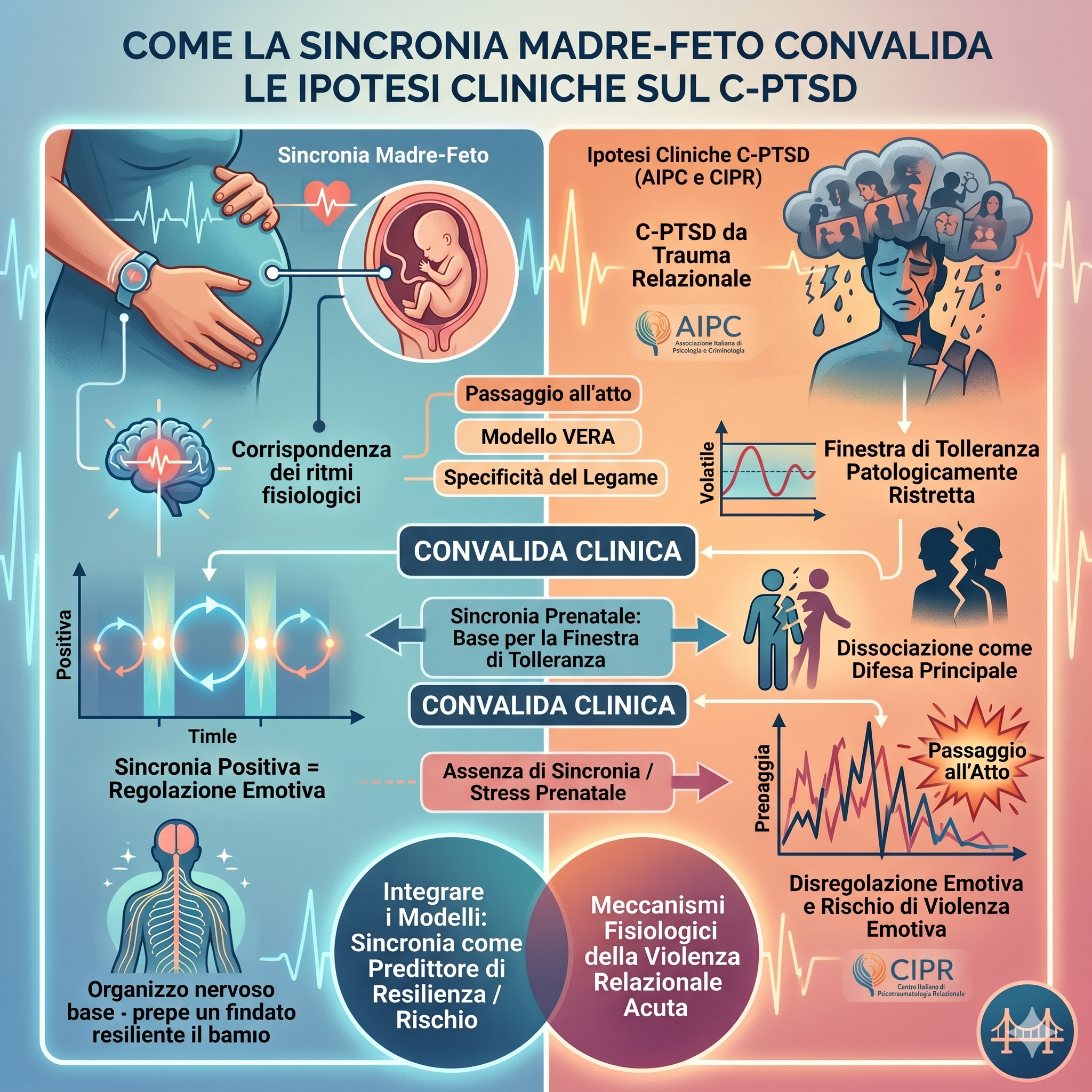
How mother-fetus synchrony could validate AIPC and CIPR clinical hypotheses on C-PTSD
1. Prenatal behavioral contagion (D'Adamo et al., 2026)
The longitudinal study conducted by D'Adamo and colleagues (2026) appears to offer a scientific validation framework for the paradigm of intrauterine biological resonance. The research examined a sample of 38 pregnant women between the 28th and 32nd weeks of gestation, measuring fetal and maternal facial responses through real-time 2D ultrasounds and automated kinematic tracking based on DeepLabCut and LSTM neural networks.
Maternal exposure to behavioral contagion video stimuli (yawning) reportedly demonstrated that fetal yawning increased significantly and selectively only in response to the mother's yawn (involving 52.8% of the fetuses in the sample). Conversely, it tended to remain close to zero during static control conditions (Still-Face) or simple lip motor movements (Open/Close).
Cross-Quantitative Recurrence Analyses (CRQA) appear to prove that True Dyads displayed a non-random temporal stability and consistency, which was markedly superior compared to artificially Recombined Dyads. Furthermore, using machine learning models, a highly preserved kinematic and motor signature was identified, linking fetal yawning to adult yawning.
The authors concluded that fetal behavior does not appear to be solely driven by isolated endogenous programs. Instead, it seems to be radically embedded in a multimodal intrauterine physiological contagion. This phenomenon appears to be mediated by biomechanical variations and the alignment of the placental neuroendocrine milieu, strongly suggesting the existence of a biological resonance and an embodied alignment that precedes birth.
2. Integration with AIPC and CIPR clinical-scientific data and hypotheses
The emerging data from the study by D'Adamo et al. (2026) appear to confirm and integrate seamlessly with the scientific evidence and clinical models developed over the years by the Italian Association of Psychology and Criminology (AIPC) and the Italian Center of Relational Psychotraumatology (CIPR) regarding the intergenerational transmission of trauma, the structuring of Complex Post-Traumatic Stress Disorder (C-PTSD), and the prevention of violent acts.
Relational traumatic resonance and the window of tolerance
The evidence that the mother-fetus dyad shares a neurophysiological synchrony fine enough to tune complex motor patterns seems to validate the AIPC and CIPR clinical hypothesis on the genesis of primary emotional dysregulation. If the intrauterine environment is chronically altered by the neurophysiological correlates of unresolved maternal trauma (traumatic experiences, neurovegetative hyperarousal, or exposure to interpersonal violence), the fetus may incorporate this relational instability.
This early alteration causes the window of tolerance in individuals with histories of prenatal and perinatal trauma to become extremely narrow. In adulthood, a reduced window of tolerance severely compromises self-regulation capabilities, exposing the individual to a potential risk of impulse control failure when faced with interpersonal triggers.
The biological roots of trauma bonding
The high temporal coherence and synchronization stability found in True Dyads appear to explain the constitutive mechanisms of trauma bonding on a deep neurobiological level. If the primary channels of embodied alignment and attunement develop within an abusive, dysfunctional, or traumatic primary relationship, the unborn child may organize their own biological survival rhythms around the threat itself.
The bond with the traumatizing figure thus becomes rooted in a primitive interoceptive and somatic memory, structuring a "relational traumatic resonance" that renders dysfunctional bonds in adulthood extremely rigid, pervasive, and resistant to change.
3. Clinical and preventive tools: The VISTA platform and the VERA protocol
AIPC and CIPR have translated these evidences into integrated operational tools, applicable both for clinical treatment and for risk assessment and prevention of severe acting-out behaviors (such as cases of domestic homicide and femminicidio).
The VISTA Platform (Valutazione Integrata Stress, Trauma e Agito - Integrated Assessment of Stress, Trauma, and Acting-Out): This digital clinical-forensic screening ecosystem allows for the mapping of traumatic experiences related to the subject's different developmental stages, including early vulnerabilities. It detects the level of impairment in emotional regulation and the impact of deep relational traumas, providing the clinical foundation for customized therapeutic pathways (which integrate advanced psychophysiological methodologies like biofeedback to expand the window of tolerance).
The VERA Protocol (Violence Emotional Risk Assessment): Strictly dedicated to risk assessment from a clinical perspective, the VERA protocol focuses on profiling the degree of familiarity variable that qualifies contexts of violence and domestic homicides. Visualized distinctively from models focused on social variables, VERA highlights how severe acting-out can configure as the outcome of a sudden collapse of impulse control. This occurs when an acute relational stimulus pushes the individual suffering from C-PTSD outside their narrow window of tolerance, automatically activating dysfunctional defensive responses.
Macro-statistical data analysis conducted by AIPC appears to indicate how, within these clinical samples, the level of education and the awareness of one's own psychophysiological functioning represent the decisive turning point between the condemnation to repeat the trauma and the real possibility of healing.
Bibliographical and institutional references
Primary research (Analyzed)
D'Adamo, G., Dall'Asta, A., Ardizzi, M., Sorrentino, S., Mora, V., Arenare, G., D'Amario, P., Capurso, M., Ferroni, F., Ischimji, D. O., Ferrari, C., Ghi, T., & Gallese, V. (2026). Prenatal behavioral contagion through maternal yawning and fetal resonance. Current Biology, 36(10), 2696-2702. https://doi.org/10.1016/j.cub.2026.04.025
Scientific references and AIPC / CIPR / ONOF Tools
Associazione Italiana di Psicologia e Criminologia (AIPC) & Centro Italiano di Psicotraumatologia Relazionale (CIPR). Clinical models on emotional dysregulation, the window of tolerance, and Complex Post-Traumatic Stress Disorder (C-PTSD). Rome-Pescara.
Osservatorio Nazionale Omicidi Familiari (ONOF - National Observatory on Domestic Homicides). Statistical reports and criminological columns on domestic and gender-based homicides through OSINT methodology.
VERA Protocol (Violence Emotional Risk Assessment): Tool for the clinical risk assessment of violent behaviors, focused on profiling the degree of familiarity variable and the loss of impulse control.
V.I.S.T.A. Platform (Valutazione Integrata Stress, Trauma e Agito): Digital system for clinical-forensic screening and monitoring of relational trauma and traumatic resonance.
AIPC and CIPR institutional contacts
Official Website: www.associazioneitalianadipsicologiaecriminologia.it
Central Email: aipcitalia@gmail.com
Active WhatsApp Line: +39 392 4401930 (Available Monday to Saturday, 11:00 AM – 4:00 PM)
AIPC Fiscal Code (C.F.): 97238660589
Main Offices: Rome (Via Giorgio Baglivi 6), Pescara (Corso Umberto 18)