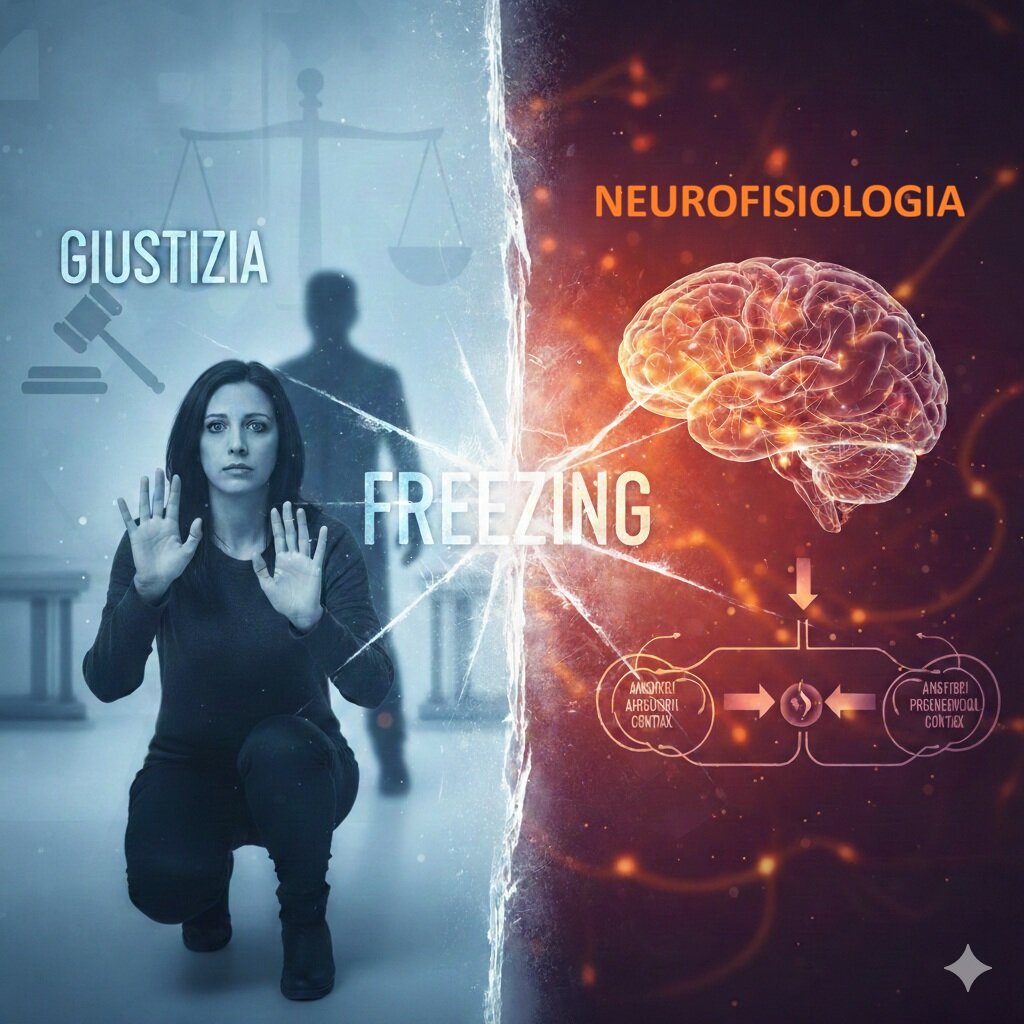
Freezing in Sexual Violence: Between Justice and Neurophysiology
A recent article in Corriere della Sera (February 3, 2026), written by Elisa Messina, reports the critical analysis of Judge Paola Di Nicola Travaglini regarding the bill on sexual violence. The judge emphasizes how the proposed legislation risks being “incomprehensible” if it does not include a clear legal management of the phenomenon of freezing and the concept of consent.
The Legal Risk and Secondary Victimization
Not considering the mechanism of freezing in the judicial context represents a concrete danger for establishing the truth:
The misunderstanding of consent: In the absence of clinical understanding, the silence or immobility of the victim can be mistakenly interpreted as tacit consent.
Psychophysical paralysis: Freezing is not a choice, but a paralysis that prevents shouting, escaping, or fighting back.
Secondary victimization: Ignoring this biological response leads to verdicts that blame the victim for “not resisting,” worsening the trauma and inhibiting reports.
Clinical Evidence: The Window of Tolerance
Since 2012, data collected through the V.E.R.A. Protocol by AIPC on a large sample of alleged victims and perpetrators confirm that physiological reactions to extreme stress manifest through emotional dysregulation.
Window of Tolerance: Each person has a range of activation within which they can react functionally. In individuals with relational trauma or C-PTSD, this window is extremely narrow.
Listen to the podcast on the AIPC Editore Channel on Spotify, MENTE|CRIME|TRAUMA: “Freezing in Sexual Violence: Between Justice and Neurophysiology.” click on the link: https://open.spotify.com/episode/5aiMERY8IEIzTuA1QWP6oG?si=ynUmFvv7Rqywc4cz7JEelQ
Hypo-activation and Freezing: When the nervous system drops below the boundaries of the window of tolerance, hypo-activation occurs. The reptilian brain, assessing the absence of escape routes, activates freezing as an extreme and involuntary defense.
Loss of control: Acting out or total immobility are due to exiting the window of tolerance and the consequent loss of control over impulses or motor skills.
Methodological Note: For the analysis of family homicides, the correct approach must be based on relational psychotraumatology and profiling the variable of the degree of familiarity, moving beyond purely social models in favor of a clinical risk assessment.
Conclusions
Effective legislation must align with the evidence of relational psychotraumatology. Recognizing that the absence of physical resistance is often the expression of a biological survival response is the only way to ensure real protection for victims.
If you would like to learn more about how the V.E.R.A. protocol specifically analyzes the variable of the degree of familiarity in gender-based homicides, I can provide you with further statistical data.
Participation and Registration
We invite professionals, institutions, and citizens to explore these topics during the Summit’s proceedings to build together a culture of prevention based on scientific evidence.
- Date: February 13, 2026
- Time: 3:00 PM – 7:00 PM
- Venue: SALA TEVERE, Lazio Region – Via C. Colombo, 212, Rome
- Registration method: Admission is free with mandatory reservation.
Contact for Accreditation:
- WhatsApp: 3924401930 (active from 11:00 AM – 4:00 PM)
- E-mail: aipcitalia@gmail.com
- Website: www.associazioneitalianadipsicologiaecriminologia.it
Support scientific research: Tax Code AIPC 97238660589.
https://gemini.google.com/share/ea2f90b8c630
Don't miss it: click on the arrow and start the video description